Colm Toibin
The News from Dublin

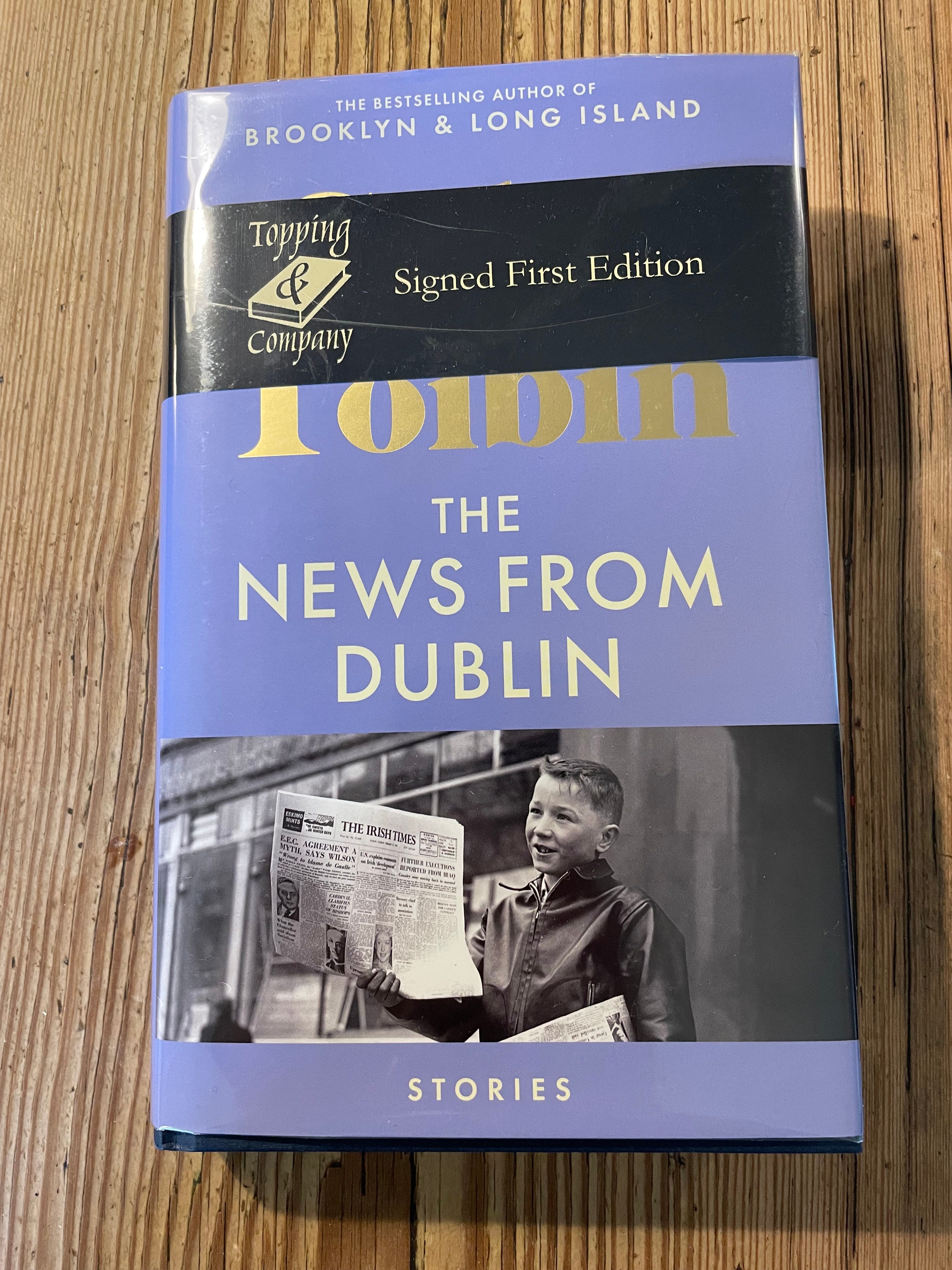
We went to Bath to hear Colm Toibin talk about his new book of short stories. It was raining, it had rained all afternoon and was still raining, and we’d forgotten what it was like to walk in the rain, the pavements slick and glistening, the cars creating waves, threatening to send up a splash that could soak your trousers and spoil the evening. It was beautiful.
Colm Toibin and his interviewer sat at the front of the church where the talk was held. He was avuncular and magisterial, confident and kind. He is a man on a grand scale. His head is the kind of head that looks like it has the capacity for much thinking; his neck is a neck that looks like it has the capacity for much talking, and his trunk is a trunk that looks like it has the capacity for great feasting. His legs, though, are delicate, like the legs of man who treads carefully, a man who could dance.
He was interviewed by one of the booksellers from Toppings, a young Polish man with a shaved head, pink cheeks and milky blue eyes. The Polish man’s approach to interviewing was chatty and adoring. He mentioned the details of a number of stories without worrying about spoilers, which was fine by me because I forget everything. He picked out moments of emotional intensity, and the silence Toibin tends to wrap these in.
Toibin talked about the process of writing. He told us that he often writes a beginning, writes and rewrites it by hand, transfers it to a laptop and revises and revises again. And then he leaves it, returning much later, maybe years later. He implied that the beginnings were the most worked part. He told us how small encounters could trigger stories. When he was a young man there were three women in a queue behind him in Barcelona. He wrote about them forty years later, imagining their lives, based on his knowledge of the relationships between his mother and her two sisters.
He talked about a novelist friend of Henry James who wrote a successful novel about French Protestant boys. When asked what she, an aristocratic Englishwoman, knew about French Protestant boys, she said that she had glimpsed some through a doorway in a Paris. He loved the idea that that could be all it took, a moment that slowly releases a knowledge that is somehow inside you, accreted from parallel experiences.
He talked about writing scenes where its obvious what will happen, climatic scenes of conflict for example, where it’s very hard to keep the dialogue fresh, to avoid cliché. If nothing unexpected is going to happen, he advised, skip the scene. You can go too far, he added, if you skip every scene, there’s no story.
He said that much of his work was autobiographical. His places were topographically accurate and he felt that gave them an emotional grounding. He talked of his compulsion to write. He said he was influenced by the parable of the talents. He said working hard, writing, was an ethical issue for him. He had to work hard. It would be wrong to waste it.
He told us a strange story about going to a psychiatrist when he was stricken with grief for his brother and couldn’t see a way through it. He was expecting to be prescribed a course of psychotherapy, but instead the psychiatrist hypnotised him. Very easily and for an hour or so, during which Toibin didn’t speak. At the end the psychiatrist said that he mustn’t tell him what he’d experienced, that it was his story, his experience, and its significance was for him. And yet he felt the need to tell it, so he put it in one of the stories in this collection, exactly as it was.
The Polish man asked him if things were only real for him whe they were told. He said that was right, experience is completed by telling.
Drinking in these pearls of top tips… goosebumps on the last line. What a delightful piece you’ve shared. Enchanting!
That is so beautifully written, Emma!