Finding New Year Confidence
watching Andrei Rublev

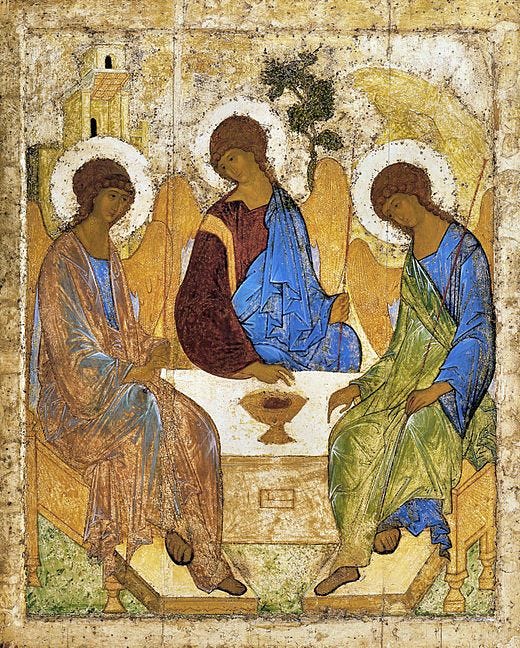
After a busy, busy Christmas, we needed a quiet New Year’s Eve this year. We wanted to stay at home but to avoid whiling away the night on so-so sitcoms. We settled on watching Andrei Tarkovsky’s 1966 film Andrei Rublev. I’ve seen it a couple of times, but no more recently than twenty years ago and my memories were vague - a sense of something being hoisted into the air – a bell? A balloon? And the memory of glory when, at the very end, we shift from black and white to colour and the paintings of Andrei Rublev are revealed.
If you don’t know the film, it tells a story about the fifteenth century priest and icon painter, Andrei Rublev – not the tennis player, though there’s a lot of confusion online. In this story, the painter is traumatised by a hideously violent raid on the town of Vladimir, where only he and a woman, Durochka, known as a holy fool, survive. During the raid, Rublev kills a man who is attempting to carry off Durochka, and to atone for the guilt he feels for this killing, Rublev takes a vow of silence and stops painting.
Years of silence end when Rublev is inspired by Boriska, a boy who is the only survivor of a bell-maker’s family who have all died of the plague. Boriska oversees the creation of a great bell, claiming that his father told him his secret of bell making, but then, terrified by his own overconfidence, he collapses in grief when the vast bell is successfully hoisted and rung. Rublev, speaking for the first time since the trauma at Vladimir, comforts Boriska, who confesses that his father never told him the secret of bell making. Boriska seems to show Rublev the chutzpa needed to create beauty. We are reminded of the opening scene of the film in which an unknown man leaps from a church tower attached to a balloon, and briefly soars. Rublev suggests that he and Boriska go together to Moscow, the boy to make bells and he himself to paint. The screen then turns to colour and presents us with the beautiful work that the real Andrei Rublev painted.
This may seem a little arcane, and it is not an easy film to watch. The violence is horrific, the narrative is not chronological, those who are dead, reappear on the screen, imagined by those who survived, and we certainly spent a fair bit of the evening wondering aloud which character was which. But the impact is huge because it deals with such a fundamental human problem: how do we bear the pain of the world, and the pain of our own failings, and yet manage to respond to life creatively? After the killing of the would-be rapist in Vladimir, Rublev imagines a conversation with his painting mentor, Theophanes the Greek. Theophanes tells him,
God will forgive you, but you must not forgive yourself. You must live between forgiveness and your own torment.
To my agnostic mind, this seems like the very best new year’s advice: we need the breadth within us to live with the tension between the pain of our inadequacy and compassion for our inadequate selves. Like the young Boriska, let’s feel the fear and make the bell anyway; like Rublev himself, let’s feel our regrets, but nonetheless paint, or write or even publish on Substack for the first time, perhaps. Happy New Year.
https://www.theguardian.com/film/2010/oct/20/andrei-rublev-tarkovsky-arthouse
The image at the top is Andrei Rublev’s The Trinity, painted in the early 1500s with thanks to wikipedia https://en.wikipedia.org/wiki/Trinity_(Andrei_Rublev)