The Compulsion to Write
Hypographia, Dostoevsky, Orwell, grief, and why I write

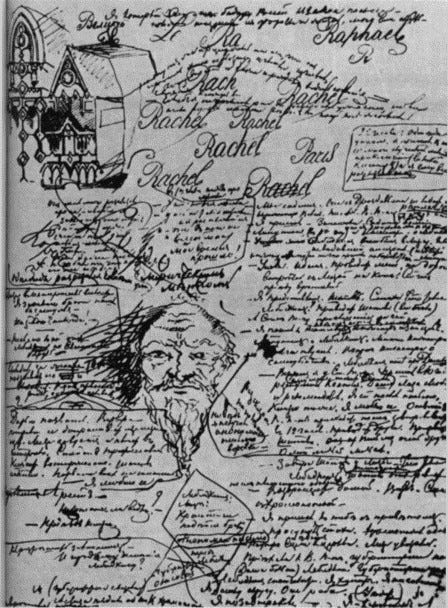
From a notebook of Fyodor Dostoevsky[i]
In his 1946 essay ‘Why I Write’, George Orwell dates his desire to ‘be a writer’ to the age ‘of five or six’. He identified what he calls the four great motives for writing, arguing that all writers will be driven by all four, to different degrees:
1. Sheer egoism – to be remembered after death
2. Aesthetic enthusiasm – loving the sounds of words, wanting to capture visual beauty, or an important experience
3. Historical impulse – understanding factual truth
4. Political purpose – changing the world
It took me a long to become a writer, but I first experienced the urge to write before I could read. I remember filling a notebook with pretend writing, a story, only to be utterly deflated when I showed it to my parents and realised it made no sense. I thought readers could read this stuff. I thought they would read it and tell me what it was about. I think that first, pre-literate desire, was about wanting to join the world of stories. I don’t think there was much egoism, and no historical or political motivation, but it could, perhaps, be categorised as ‘aesthetic enthusiasm.’
I recognize all of Orwell’s impulses, but I think my main motive for writing now is a defence against loss: loss of memory, bereavement. Most mornings, I write about the previous day, and my imagined audience is my more elderly self, who wants to be reminded of forgotten life. My first sustained phase of morning writing was in the wake of the death of our baby son more than thirty years ago. I had two very young children, and in order to find time to write, I had to get up really early. We had our children in our bed, and I would usually wake, before dawn, to the dampness of breast milk overflow (it seems unfair to call it vomit) on one side of me, and the dampness of pee on the other. We were all quite fragile. I would gently extricate myself from the young bodies, shower, make coffee and write for half an hour, an hour. It kept my sanity. I wrote about Stan, who’d died. He’d only lived for five days. It took me a year until I felt I’d written what I needed to write.
More recently, my writing has been driven by an obsession with the past, the loss of what I have never known, but for tantalising traces. I’ve just finished a book that I’ve been writing for seven years. The opening chapter is called Compulsion.
At its most extreme, the compulsion to write is considered to be an illness, caused by a brain disorder. There’s a condition called hypergraphia which is a compulsion to write or draw or both, to make some kind of meaning by making shapes with a pen on a page, or fingers on a keyboard. It’s associated with temporal lobe epilepsy. People who have it write endless lists, detailed diary accounts of their activities and dreams. A study by Waxman and Geschwind, first published in 1974, presented the case of a young woman who wrote for several hours a day. She wrote because ‘I want to be sure of what I do.’ She recorded her days to guard against the memory loss caused by her seizures. She always carried writing materials but sometimes ended up writing on ‘scraps of paper, napkins’. She wrote in detail about ‘seizures, hallucinations, and feelings of déjà vu.’ She wrote catalogues of her possessions, lists of likes and dislikes, and poetry which was often concerned with ethics or philosophy, the meaning of life. She said she had written out the lyrics of a particular song hundreds of times; occasionally she wrote a single word over and over again, or copied the labels printed on things she’d bought. She wasn’t interested in reading.
This description of her writing includes much that will seem very normal to most writers – writing for several hours a day (if you have the chance), writing to remember, keeping materials to hand. The obsessive repetition takes me back to being a young teenager, when artistic renditions of a fancied boy’s name, could function as a placeholder for connection. But the compulsion is seen most clearly when the point of the exercise is least obvious - writing out song lyrics again and again – and the lack of reading is a worry. Most people who write are interested in other people’s writing: reading is what opens us up to the clever things that writing can do.
The Russian writer Fyodor Mikhailovich Dostoevsky was a keen reader who is also believed to have experienced hypergraphia. He was twenty-nine when he experienced his first epileptic seizure whilst imprisoned in a penal camp in Siberia. We know from his extensive letters and diaries that he immersed himself in the texts of not only the great Russian writers like Pushkin and Gogol but also European writers like Shakespeare, Cervantes, and Goethe, and this may have been what have enabled him to develop his extraordinary writing skills and to use his condition to create compelling works of fiction. The page of his writing shown above, presented in a 2005 article in the journal Seizures, shows many hypergraphic features: every inch of paper is covered with words and sketches; certain words, and variations of them, are written again and again. The intensity of writing overwhelms any intention to communicate. The article identifies qualities in his novels which the authors see to be influenced by his illness:
His language is nervous, tense and impulsive. His phrases are sometimes long and complicated, containing a fanciful conglomeration of colloquial words and expressions, official, journalistic and scientific terms, and slips of the tongue, foreign words, names and quotations. But now and then we can see here very short, elliptic phrases. Dostoevsky’s favorite word was “vdrug” (“suddenly”). A lot of events in Dostoevsky’s novels begin suddenly, without preparations and explanation – like seizures. Dostoevsky also used frequent repetitions of the same word with different intonations. It made an impression of convulsions and shocked the literary critics.
It is as if Dostoevsky’s seizures intensified his ‘aesthetic enthusiasm’. He appreciated his epilepsy for giving him moments of “unbounded joy and rapture, ecstatic devotion and completest life.” But he regretted the corrosive effect on his memory.[ii] As readers, we are the beneficiaries of both these impacts, both compelling his writing. A full list of his works is here. If you’re new to Dostoevsky, I’d recommend starting with Crime and Punishment.
[i] Christian R. Baumann, Vladimir P.I. Novikov, Marianne Regard, Adrian M. Siegel,‘Did Fyodor Mikhailovich Dostoevsky suffer from mesial temporal lobe epilepsy?’ Seizure, Volume 14, Issue 5, 2005, Pages 324-330.
[ii] https://www.pbs.org/newshour/health/for-dostoevsky-epilepsy-was-a-matter-of-both-life-and-literature